
Table of Contents
- The Nature of the Personal Project
- The Role of the Supervisor
- The Role of the Student
- The Role of the Community
- Objectives
- Time Frames
- Gathering Evidence of the Process
- Evidence of the Process
- Defining the Project
- Ideas to help students define the project
- Cycle of inquiry
- Success Criteria
- Action Plan
- Applying the ATL Skills
- Reflecting
- Evaluating the Product
- Criterion A: Planning Rubric
- Criterion B: Applying Skills Rubric
- Criterion C: Reflecting Rubric
- Notes about Impact of the Project
- Report
- Personal Project Grade Descriptors
The Nature of Personal Project
The personal project provides an opportunity for students to undertake an independent and age- appropriate exploration into an area of personal interest. Through the process of inquiry, action and reflection, students are encouraged to demonstrate and strengthen their approaches to learning (ATL) skills.
Below are ideas to help students understand the nature of the personal project.
- What do you think a personal project is?
- What is a personal project for?
- Who could be involved in your personal project?
- When do you complete your personal project?
- How much time will you spend on your personal project?
This document is a guide for students to help them complete the various steps of their personal project independently.
The Role of the Supervisor
The purpose of the supervisor is to support the student during the personal project. Each student has his or her own supervisor.
The supervisor’s responsibilities are to provide guidance to students in the process and completion of the project:
- ensuring the chosen MYP project topic satisfies appropriate legal and ethical standards with regard to health and safety, confidentiality, human rights, animal welfare and environmental issues
- giving guidelines about the MYP project
- providing a timetable with deadlines
- providing the assessment criteria for the project
- giving advice on how to keep and curate evidence of the process
- emphasizing the importance of personal analysis and reflection
- providing formative feedback
- ensuring requirements for academic integrity are met
- confirming the authenticity of the work submitted
- assessing the MYP project using the criteria in this guide
- participating in the standardization of the assessment process
- providing personal project teacher assessed totals to the MYP coordinator to enter in the International Baccalaureate Information System (IBIS).
Students should receive information and guidance that includes:
- Guidelines about the MYP project
- A timetable with deadlines
- The assessment criteria for the project
- Advice on how to keep and use a process journal
- The importance of personal analysis and reflection
- Formative feedback
- Requirements for academic honesty
Supervisors will support students throughout the personal project. The frequency of meetings between students and their supervisor may change according to the type of project, the topic, characteristics of the students involved or the stages of the project. Supervisors are advised not to become project experts.
The Role of the Student
To complete a personal project, students must undertake independent learning. They are expected to spend approximately 25 hours on their personal project. This time covers the whole process, including meetings with their supervisor.
Through the personal project, students:
- explore an interest that is personally meaningful (intellectual curiosity; family connection;
- social, cultural or geographical relevance; individual passion; etc)
- Take ownership of their learning by undertaking a self-directed inquiry
- Transfer and apply skills in pursuit of a learning goal and the creation of a product
- Recognize and evidence personal growth and development.
Specifically, students must:
- establish a goal, an action plan and success criteria
- apply ATL skills throughout the project process
- gather evidence of how they have applied ATL skills throughout the
- personal project
- evaluate the project based on the success criteria
- select evidence to add to the report
- reflect on the impact of the project
- write a report.
The Role of the Community
Many members of the community, both within and beyond the school, can support the personal project.
Within the School (examples)
- Librarian
- Specialist teacher
- Technician (special education, recreation etc)
- Administrator
- MYP Coordinator
Beyond the School (examples)
- Pharmacist
- Artist
- Athlete
- YouTuber
- Psychologist
- Mechanic
A resource person can be useful during the research process or when complete in the product.
Objectives
❖ Three objectives under pin a valid and reliable evaluation of the project.
❖ Each objective corresponds to a section of the report.
| Planning | Applying Skills | Reflecting | |
| Learning Goal | State a learning goal for the project and explain how a personal interest led to that goal | Explain how the ATL skill(s) was/were applied to help achieve their learning goal | Explain the impact of the project on themselves or their learning |
| Product | State an intended product and develop appropriate success criteria for the product Present a clear, detailed plan for achieving the product and its associated success criteria | Explain how the ATL skill(s) was/were applied to help achieve their product | Evaluate the product based on the success criteria |
Time Frames
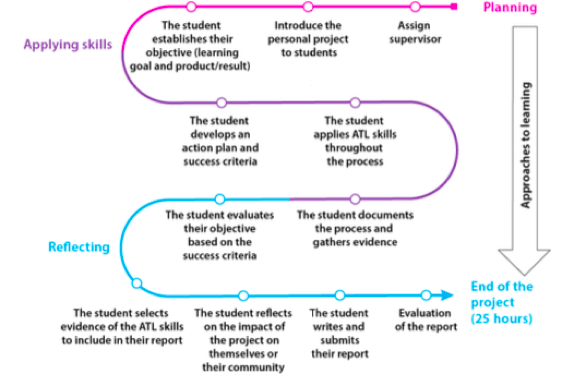
To complete the personal project, students must follow the following steps.
Gathering Evidence of the Process
Students are expected to document the process they followed to complete their project. In this way, they can demonstrate how they developed ATL skills and their academic honesty. Students must master different techniques for gathering evidence using portfolios, design projects, interdisciplinary projects or any other activity carried out during the project.
Students are not restricted to any single model for gathering evidence; however, they are responsible for producing evidence that shows they have fulfilled the personal project’s objectives. To foster their independence, students must develop their own ways of gathering evidence and of using media of their choosing, which can be written, visual, audio, digital or a combination of these.
Possible evidence may include:
- visual thinking diagrams (mind maps)
- bulleted lists
- charts
- short paragraphs
- notes
- timelines, action plans
- annotated illustrations
- annotated research
- artifacts from inspirational visits to museums, performances, galleries
- pictures, photographs, sketches
- up to 30 seconds of visual or audio material
- screenshots of a blog or website
- self- and peer-assessment feedback.
Evidence of the Process
| Evidence of the process is | Evidence of the process is not: |
| • gathered throughout the project to document its development • an evolving record of intents, processes, accomplishments • a collection of initial thoughts and developments, brainstorming, possible lines of inquiry and further questions raised • a record of interactions with sources, for example, teachers, supervisors, external contributors • a record of selected, annotated and/or edited research and to maintain a bibliography • a collection of useful information, for example, quotations, pictures, ideas, photographs • a means of exploring ideas and solutions • a place for evaluating work completed • reflection on learning • devised by the student | • collected on a daily basis (unless this is useful for the student) • written up after the process has been completed • additional work on top of the project; it is part of and supports the project • a diary with detailed writing about what was done (unless this is useful for the student) • a single, static document with only one format (unless this is useful for the student). |
Defining the project
The personal project is truly personal because each student sets their own goal based on something that they find interesting. Students may draw inspiration from their prior experience in the MYP, such as:
- a global context that they find particularly compelling
- A service as action experience that they would like to build on
- a unit of inquiry that they would like to explore further.
Similarly, students may draw inspiration from their interests and hobbies outside school. They may also consider developing new ones.
The project consists of two interrelated parts:
- a learning goal (what the student wants to learn)
- a product (what the student wants to create).
The project can change, if necessary, during the process.
The project’s starting point may be either the learning goal or the product. One learning goal can lead to different products, just as one product can relate to a variety of learning goals.
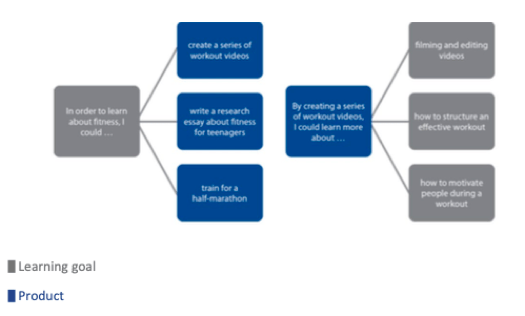
An example of starting with a learning goal to guide the creation of the project:
- I want to learn about fitness by training for a half-marathon.
An example of starting with a product to guide the creation of the project:
- I want to create a series of workout videos to learn more about filming and editing videos.
Ideas to help students Define their project
- What have you always wanted to do?
- What do you do in your free time?
- What would you like to do in your free time?
- What IB learner profile attribute best describes you?
- What IB learner profile attribute would you like to develop?
- Which global context interests you the most?
- Which interdisciplinary or design project interested you the most?
- Which experience of service as action did you find the most satisfying?
- What problem within your community most affects you?
- Which is your favourite academic discipline?
- Which research project would you like to develop?
Cycle of Inquiry
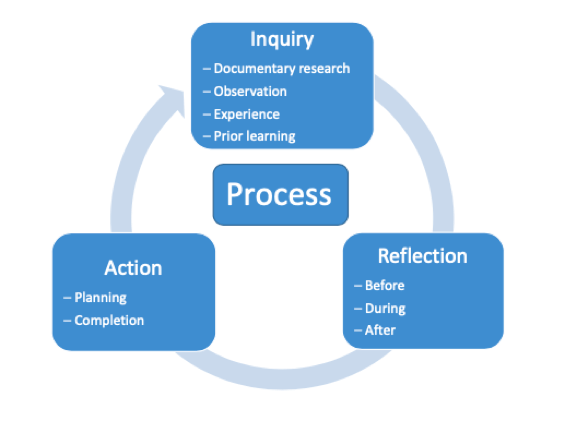
MYP personal projects are student-centered and age-appropriate. They enable students to engage in practical explorations through a cycle of inquiry, action and reflection.
Success Criteria
The success criteria, developed by the student, measure the degree of excellence to which the product aspires or the terms under which the product can be judged to have been successful.
❖ The success criteria must be testable, measurable and observable.
❖ The success criteria must evaluate the product.
❖ The success criteria must evaluate the impact on the student or the community.
Below are ideas of specific product features that may help students establish success criteria to evaluate the quality of their products.
Product form:
- technique or material
- used
- number of pages
- length
- resource people
- visual aspects
- colours
- size
- text type
Product content:
- strand
- target audience
- organization
- quality of the language
- result achieved
Action Plan
“A detailed plan outlining actions needed to reach one or more goals.”(Wikipedia)
Working with the timeline provided by the school, students plan the time they need to spend on their personal projects by drawing up a timetable that gives them an overall view of everything they have to achieve. They can then add daily or weekly details showing everything they have to do.
The action plan must show how students will create the product and fulfill the success criteria.
For this step of the project, students may draw inspiration from similar action plans created for the individuals and societies subject.
The project is split into three main steps that correspond to the objectives.
Planning
- Defining the project (learning goal and product)
- Developing the success criteria
- Presenting a plan
Applying skills
- Achieving the learning goal
- Completing the product
Reflecting
- Explaining the impact of the project on themselves or their learning
- Evaluating the product based on the success criteria
*Students must regularly revisit this plan to document and explain any changes to the expected deadlines.
Applying the ATL Skills
To complete the project, students must work through different steps to explore the learning goal and achieve the product.
Below are some ideas of how to do this.
- Planning resources (financial, human and material) and constraints
- Producing drafts, sketches, prototypes, plans, etc
- Choosing information, techniques and materials base on the research
- Testing techniques and materials
- Compiling a list of purchases
- Predicting other possibilities
- Planning the documents to produce (survey, letter, poster, visual aids, etc)
- Preparing meetings (interviews, surveys, presentations, resource people, etc)
- Practicing a presentation
- Creating
- Regularly assessing their work to see if the product helps achieve the learning goal; this could be a self-assessment or an assessment by another person
- Making necessary improvements
- Presenting the Product
Which ATL skills will be useful for your project?
- Review the ATL Guide
- Define the specific skills for each category (communication, collaboration, organization, affective, reflection, information literacy, media literacy, critical thinking, creative thinking, transfer) that you will need.
- Identify how you will gather your evidence.
Reflecting
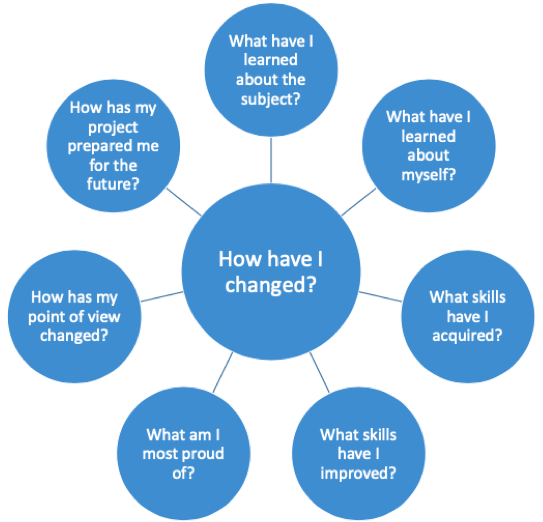
Impact: “both negative and positive planned and unplanned consequences of a completed project, including those that only emerge sometime after the project ends”. (Translated from Guide de préparation d’un plan d’évaluation de projet, TÉLUQ.)
Below are ideas to help students assess the impact of their projects
Evaluating the Product
Below are ideas to help students evaluate their products based on their chosen success criteria.
- To what extent did I complete my product based on the success criteria?
- How can I demonstrate that I completed my product based on my success criteria?
- What are my project’s strengths?
- What could I have done differently to make my product better reflect my success criteria?
Criterion A: Planning
Maximum: 8
In the personal project, students should be able to:
i. state a learning goal for the project and explain how a personal interest led to that goal
ii. state an intended product and develop appropriate success criteria for the product
iii. present a clear, detailed plan for achieving the product and its associated success criteria.
| Achievement Level | Descriptor |
| 0 | The student does not achieve a standard described by any of the descriptors below. |
| 1-2 | i. states a learning goal ii. states their intended product iii. presents a plan that is superficial or that is not focused on a product. |
| 3-4 | i. states a learning goal and outlines the connection between personal interest(s) and that goal ii. states their intended product and presents basic success criteria for the product iii. presents a plan for achieving the product and some of its associated success criteria. |
| 5-6 | i. states a learning goal and describes the connection between personal interest(s) and that goal ii. states their intended product and presents multiple appropriate success criteria for the product iii. presents a detailed plan for achieving the product and most of its associated success criteria. |
| 7-8 | i. states a learning goal and explains the connection between personal interest(s) and that goal ii. states their intended product and presents multiple appropriate, detailed success criteria for the product iii. presents a detailed plan for achieving the product and all of its associated success criteria. |
Definitions
- Learning Goal: What students want to learn as a result of doing the personal project.
- Product: What students will create for their personal project.
- Presents: Offer for display, observation, examination or consideration.
- State: Give a specific name, value or other brief answer without explanation or calculation.
- Outline: Give a brief account or summary.
- Describe: Give a detailed account or picture of a situation, event, pattern or process.
- Explain: Give a detailed account including reasons or causes.
Criterion B: Applying Skills
Maximum: 8
In the personal project, students should be able to:
i. explain how the ATL skill(s) was/were applied to help achieve their learning goal
ii. explain how the ATL skill(s) was/were applied to help achieve their product.
| Achievement Level | Descriptor |
| 0 | The student does not achieve a standard described by any of the descriptors below. |
| 1-2 | i. states which ATL skill(s) was/were applied to help achieve their learning goal ii. states which ATL skill(s) was/were applied to help achieve their product. |
| 3-4 | i. outlines which ATL skill(s) was/were applied to help achieve their learning goal, with superficial examples or evidence ii. outlines which ATL skill(s) was/were applied to help achieve their product, with superficial examples or evidence. |
| 5-6 | i. describes how the ATL skill(s) was/were applied to help achieve their learning goal, with reference to examples or evidence ii. describes how the ATL skill(s) was/were applied to help achieve their product, with reference to examples or evidence. |
| 7-8 | i. explains how the ATL skill(s) was/were applied to help achieve their learning goal, supported with detailed examples or evidence ii. explains how the ATL skill(s) was/were applied to help achieve their product, supported with detailed examples or evidence. |
Definitions
- Learning Goal: What students want to learn as a result of doing the personal project.
- Product: What students will create for their personal project.
- ATL Skill(s) Clusters: One or more of: communication, collaboration, organization, affective, reflection, information literacy, media literacy, critical thinking, creative thinking, transfer.
- State: Give a specific name, value or other brief answer without explanation or calculation.
- Outline: Give a brief account or summary.
- Describe: Give a detailed account or picture of a situation, event, pattern or process.
- Explain: Give a detailed account including reasons or causes.
Criterion C: Reflecting
Maximum: 8
In the personal project, students should be able to:
i. explain the impact of the project on themselves or their learning
ii. evaluate the product based on the success criteria.
| Achievement Level | Descriptor |
| 0 | The student does not achieve a standard described by any of the descriptors below. |
| 1-2 | i. states the impact of the project on themselves or their learning ii. states whether the product was achieved. |
| 3-4 | i. outlines the impact of the project on themselves or their learning ii. states whether the product was achieved, partially supported with evidence or examples. |
| 5-6 | i. describes the impact of the project on themselves or their learning ii. evaluates the product based on the success criteria, partially supported with evidence or examples. |
| 7-8 | i. explains the impact of the project on themselves or their learning ii. evaluates the product based on the success criteria, fully supported with specific evidence or detailed examples. |
Definitions
- Product: What students will create for their personal project.
- State: Give a specific name, value or other brief answer without explanation or calculation.
- Outline: Give a brief account or summary.
- Describe: Give a detailed account or picture of a situation, event, pattern or process.
- Explain: Give a detailed account including reasons or causes.
- Evaluate: Make an appraisal by weighing up the strengths and limitations.
Notes about impact of the project
- could refer to any aspect of having done the project: inquiry, action and/or reflection
- could include progress made towards the learning goal
- could include ways in which the student has grown as a learner, such as improvement in the ATL skills or learner profile attributes
- could include ways in which the student has grown or changed as a result of the project.
Report
There are two possible formats for the MYP personal project report: written and/or oral. Students can combine these formats in a multimedia report.
Students may submit their report in written or recorded format, or a combination of the two. The table below shows the maximum length of students’ submissions.
- To ensure that the written part of the report is clearly legible, each page must have a minimum:
- 11-point font size
- 2 cm margins
- Evidence presented in images must be clearly visible at the size submitted.
- Visual aids may be used to support spoken reports. However, evidence and examples presented in the visual aids should be submitted as documents. Visual aids presented only in video format will not be considered for assessment.
- The bibliography is uploaded separately and is not included in the page limit.
- Please do not include a title page; if included it will count towards the page limit.
| Document File Types .doc, .docx, .pdf, .rit | Recording File Types: mp3, m4a, mov, codex H264, m4v | |
| 15 pages | and | No recording |
| 14 pages | and | 1 minute |
| 13 pages | and | 2 minute |
| 12 pages | and | 3 minute |
| 11 pages | and | 4 minute |
| 10 pages | and | 5 minute |
| 9 pages | and | 6 minute |
| 8 pages | and | 7 minute |
| 7 pages | and | 8 minute |
| 6 pages | and | 9 minute |
Personal Project Grade Descriptors
| Grade | Descriptor |
| 1 | Produces work of a very limited quality. Conveys many misunderstandings of the process of learning independently. Very rarely demonstrates critical thinking. Very inflexible, rarely shows evidence of knowledge or skills. |
| 2 | Produces a report of limited quality. Communicates limited understanding of the process of learning independently. Demonstrates limited evidence of critical thinking. Limited evidence of transfer of knowledge or approaches to learning skills into the project. |
| 3 | Produces an acceptable report. Communicates basic understanding of the process of learning independently through the project. Begins to demonstrate some basic critical thinking. Begins to transfer knowledge and approaches to learning skills into the project. |
| 4 | Produces a good-quality report. Communicates basic understanding of the process of learning independently through all stages of the cycle of inquiry. Often demonstrates critical thinking. Transfers some knowledge and some approaches to learning skills into the project. |
| 5 | Produces a generally high-quality report that demonstrates a thorough process. Communicates good understanding of the process of learning independently through all stages of the cycle of inquiry. Demonstrates critical thinking, sometimes with sophistication. Usually transfers knowledge and approaches to learning skills into the project. |
| 6 | Produces a high-quality report that demonstrates a thorough process. Communicates extensive understanding of the process of learning independently through all stages of the cycle of inquiry. Demonstrates critical thinking, frequently with sophistication. Transfers knowledge and approaches to learning skills into the project. |
| 7 | Produces a high-quality report that demonstrates a thorough process. Communicates comprehensive, nuanced understanding of the process of learning independently through all stages of the cycle of inquiry. Consistently demonstrates sophisticated critical thinking. Successfully transfers knowledge and approaches to learning skills into the project with independence. |
 Personal Project Hacks